Updated 19 September 2026
Our working
We are designing these shorts in the open. This page is the research we have done and the mock-ups we are designing from — including the ones a computer generated, clearly marked as such.
Most brands show you the finished thing and nothing else. We do not have a finished thing yet, so here is the working instead.
Two kinds of picture on this page
Built by a script from real numbers, and reproducible. If you ran the same code you would get the same picture. These are findings.
Generated by an AI image tool. We use these to look at shape, styling and how a print might sit on a garment — nothing more. They are not photographs, they are not the product, and the finished shorts will differ. Shown with a dashed border throughout.
There are no photographs of the product anywhere on this site, because the product does not exist yet. When it does, real photographs will replace the mock-ups and we will say so.
The board
Everything we have made to answer a question we actually had. The measured work runs down the outside; the middle column is the AI mock-ups, so you can tell at a glance which is which. The full write-up of the first study is here.
These are AI-generated
Every image below was made by an AI image tool. They are not photographs and they are not the product. We use them to look at silhouette, styling and how a print might read on a garment, and they go no further than that — they are never sent to a factory and no measurement is ever taken from one.
They get things wrong. The shorts in these are longer than the ones we are specifying, and there is a badge on the leg that we are not making. That is the normal state of a working mock-up, and it is why they are labelled.
Measured
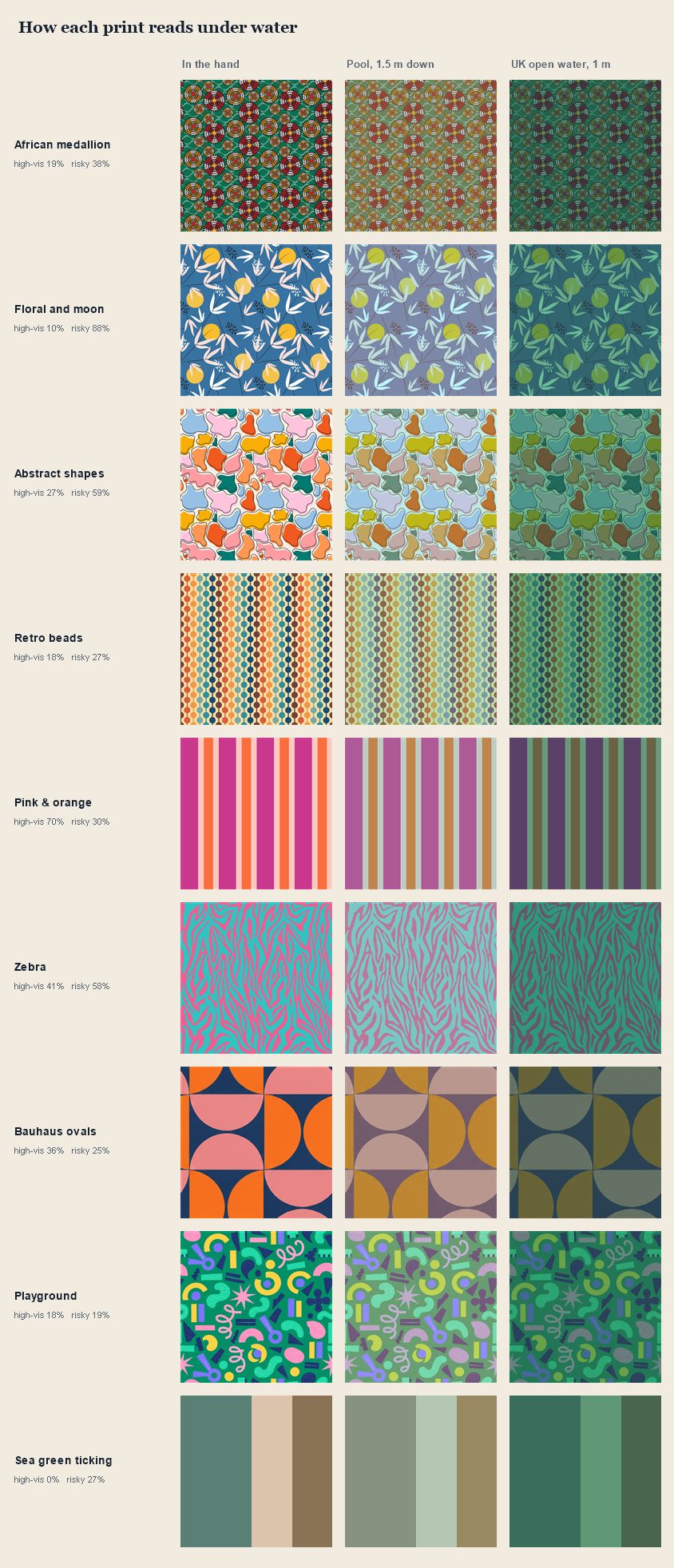
Every print, at depth. Each one as printed, then modelled at 1.5 m in a pool and 1 m in British open water. Light is absorbed on the way down and again on the way back to your eye, and the water's own colour fills in behind. This is the analysis that made us change the range.
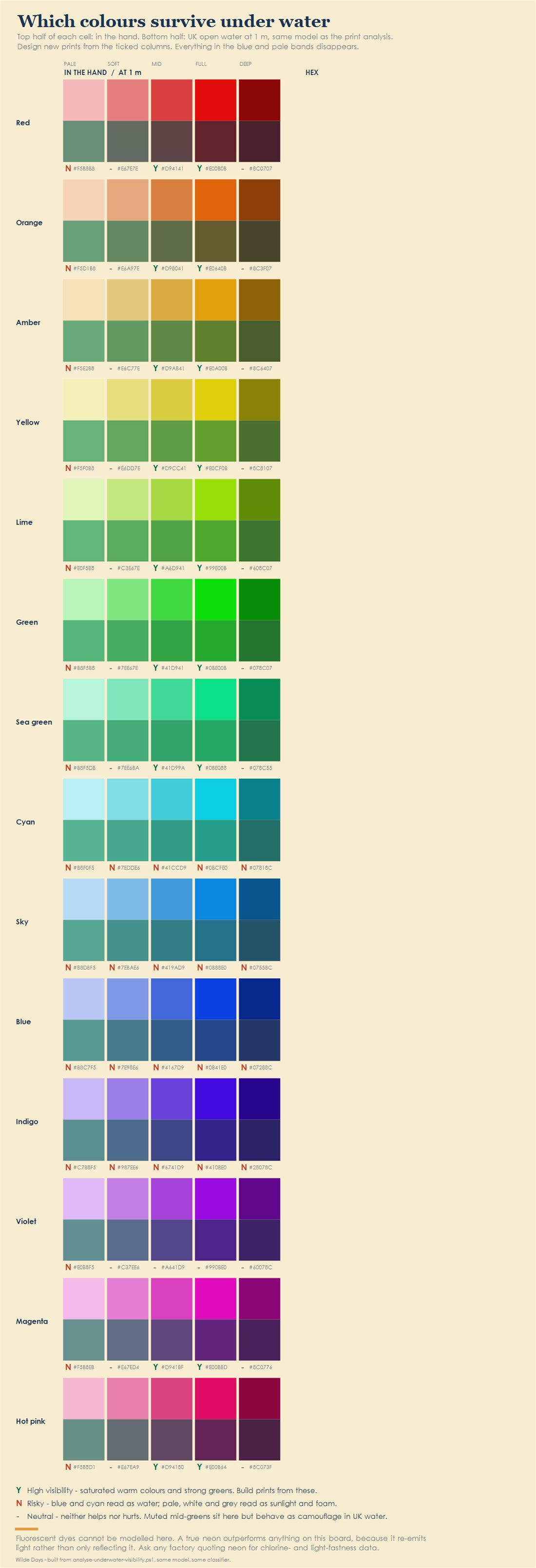
Which colours survive, before any print is drawn. Fourteen hues at five strengths, each shown in the hand and at a metre down. Eighteen pass. Every pale tone fails, and so does every blue and cyan at every strength — which is awkward, because blue is the most common colour in children's swimwear.
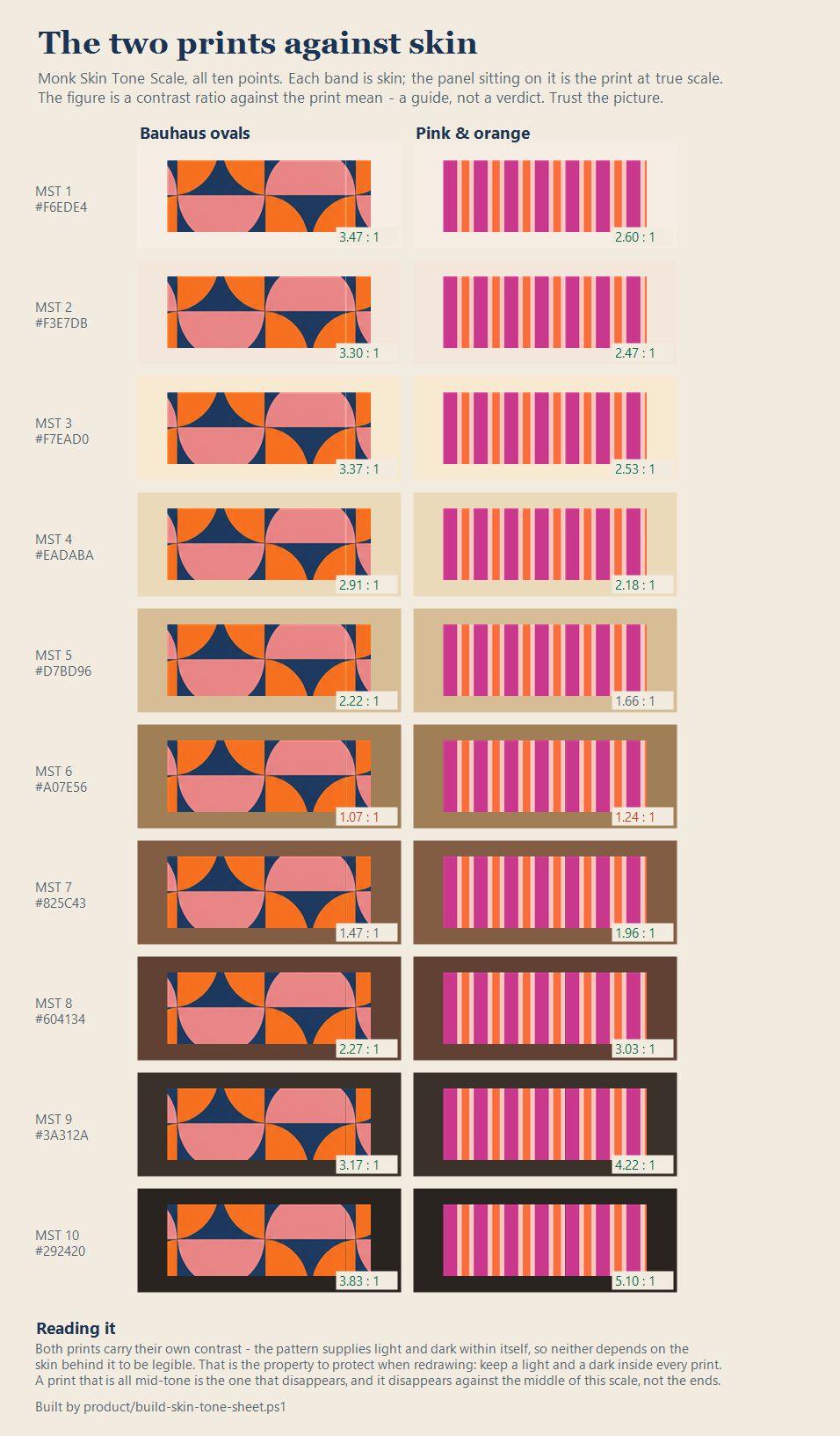
How the prints sit against skin. All ten points of the Monk Skin Tone Scale, with a contrast figure under each. The useful finding: both prints carry their own light and dark inside the pattern, so neither depends on the skin behind it. A print that is all mid-tone is the one that disappears.
AI mock-ups
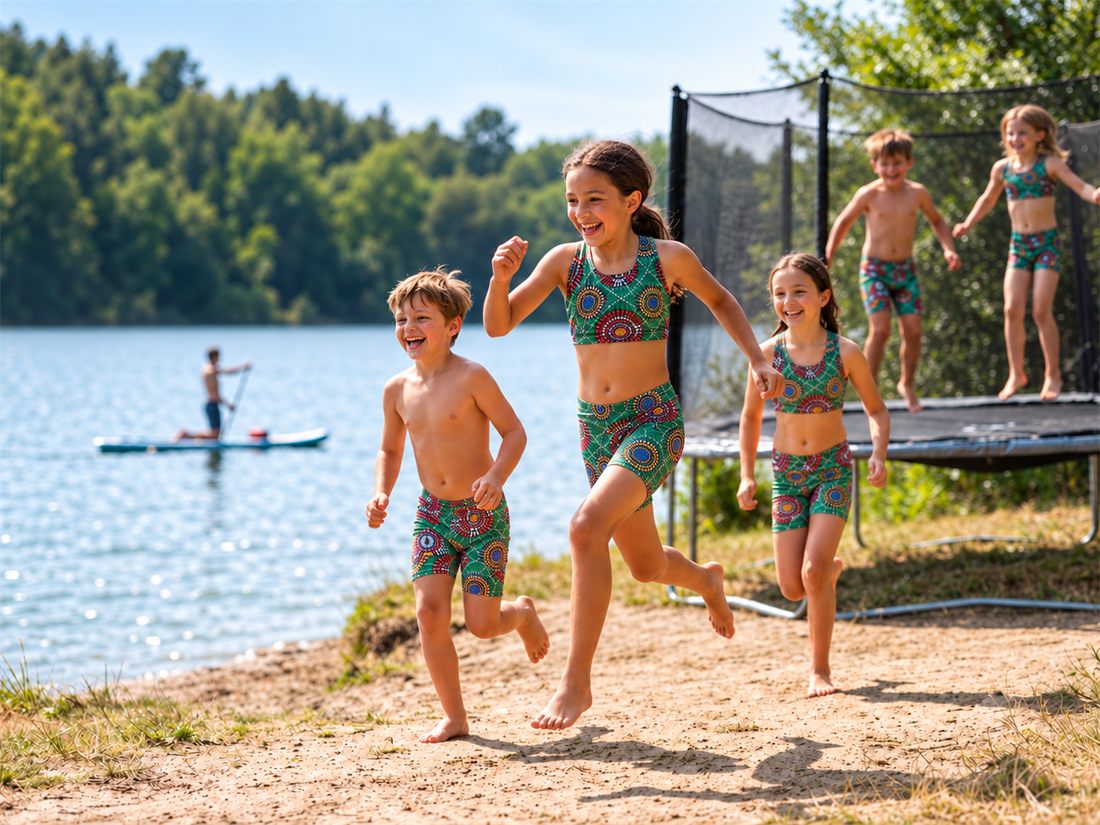
Not a beach. This is the one that tests the whole idea. A lake, a trampoline, dry land, no changing room — if the shorts only make sense at the seaside then we have designed swimwear, which is not what we set out to do. Made to see whether they still look right away from water.
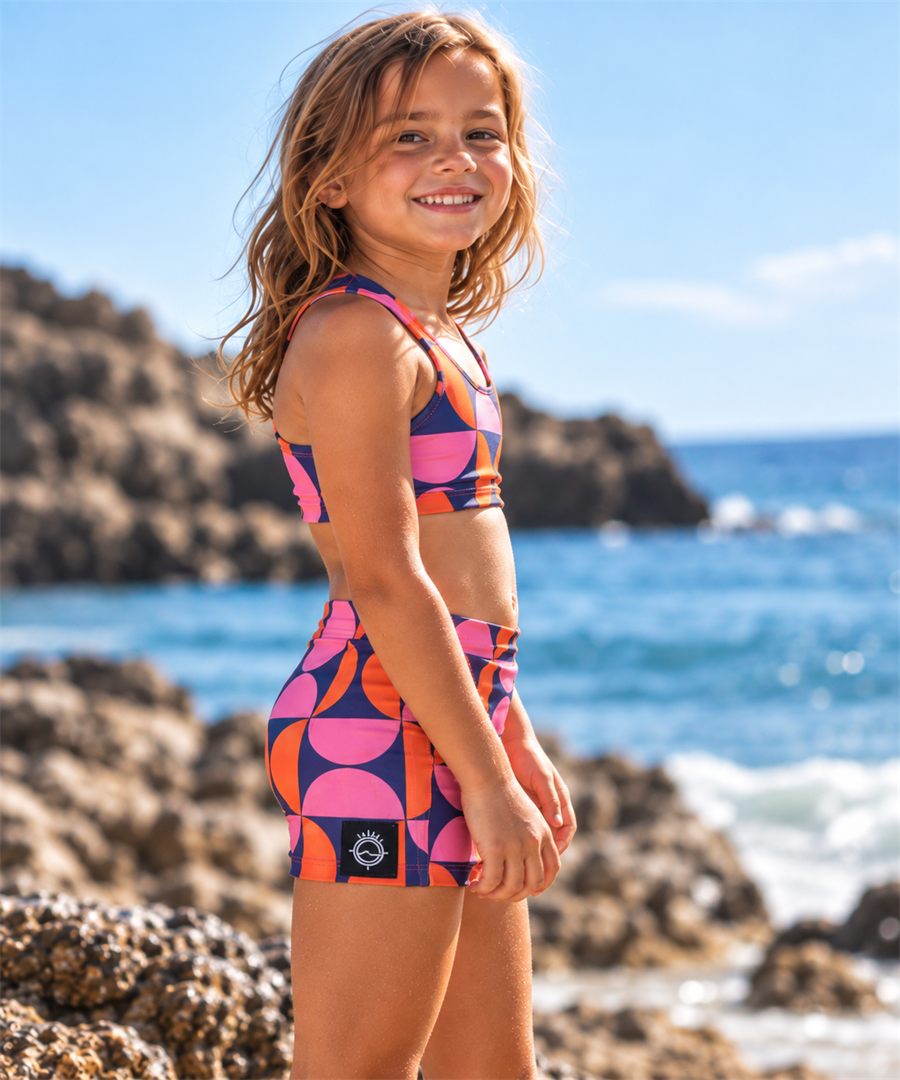
Bauhaus, our own drawing. One of three prints we drew ourselves rather than licensed. It scores 36% high-visibility and the lowest risk in the range — the only dark ground we have that still reads under water, because the orange and pink do the work the navy cannot.
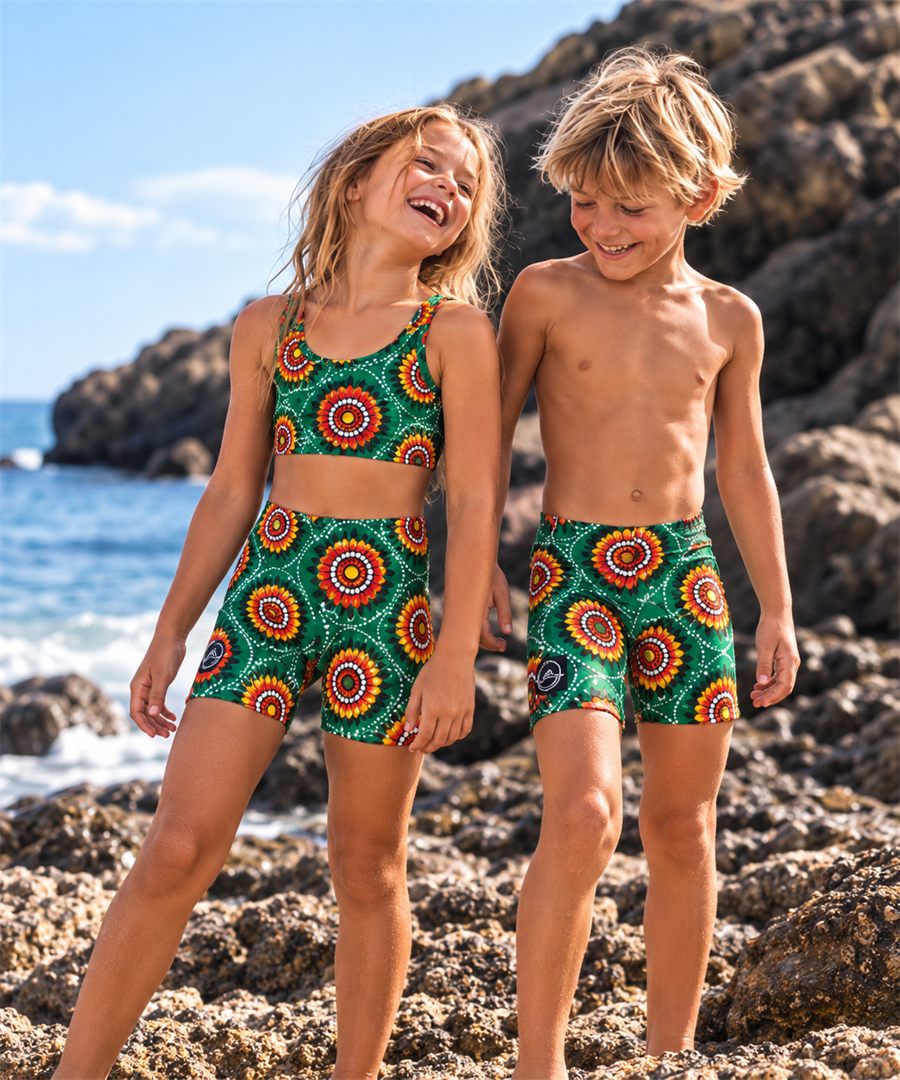
Medallion, at a size we could actually print. Large motifs on a dark green ground. Useful for one thing in particular: seeing whether a bold print still reads as a pattern on a small garment, or whether the child is just wearing one flower.
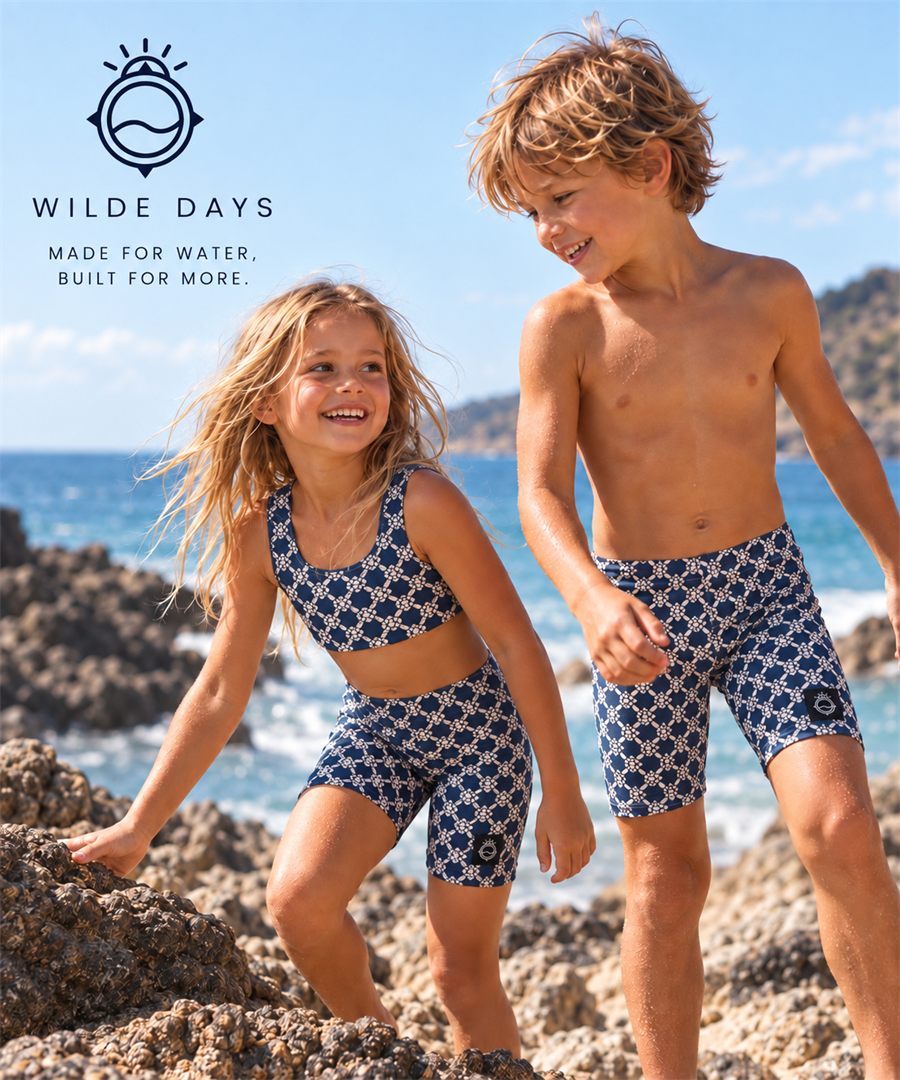
Turtle print, on the rocks. Made to see how a small, dense, two-colour print reads at a distance and in motion. It answered the question — it holds together as a pattern rather than turning to texture. The coast is not Cornish and the length is wrong, which tells you how much to trust the details.
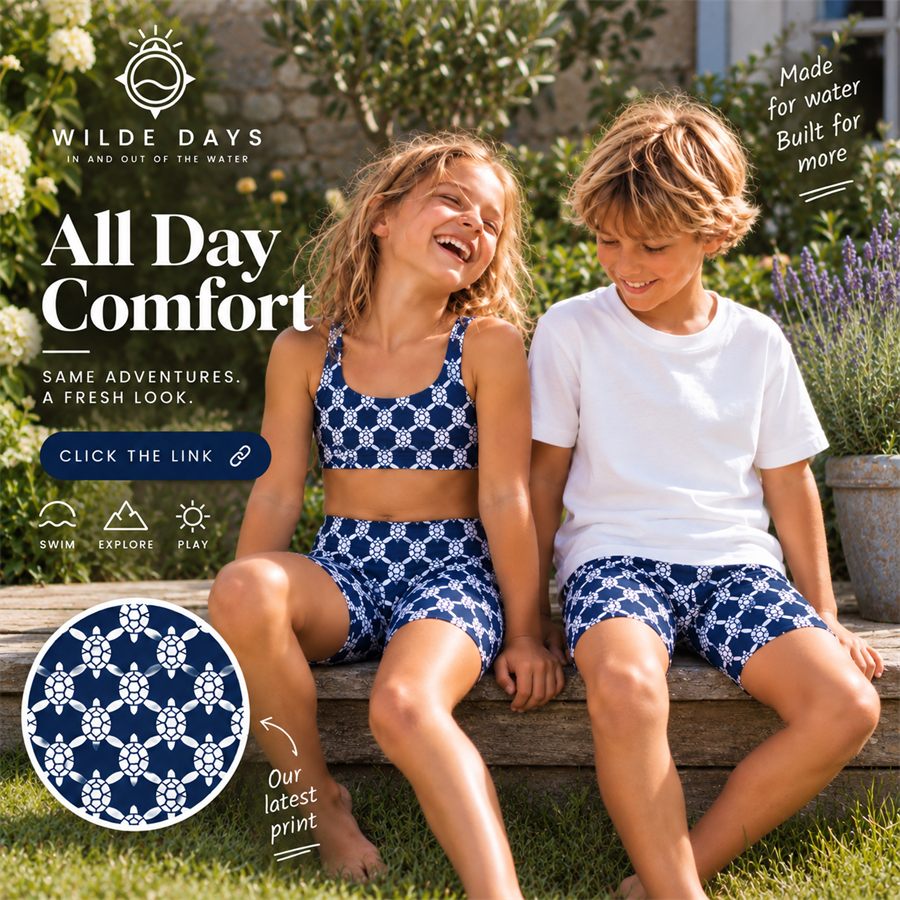
The same print out of the water. The whole point of these is that they are not just swim shorts, so this one was made to look at them on dry land with a t-shirt. Same caveats: the cut is not ours and the badge is not happening.
Measured
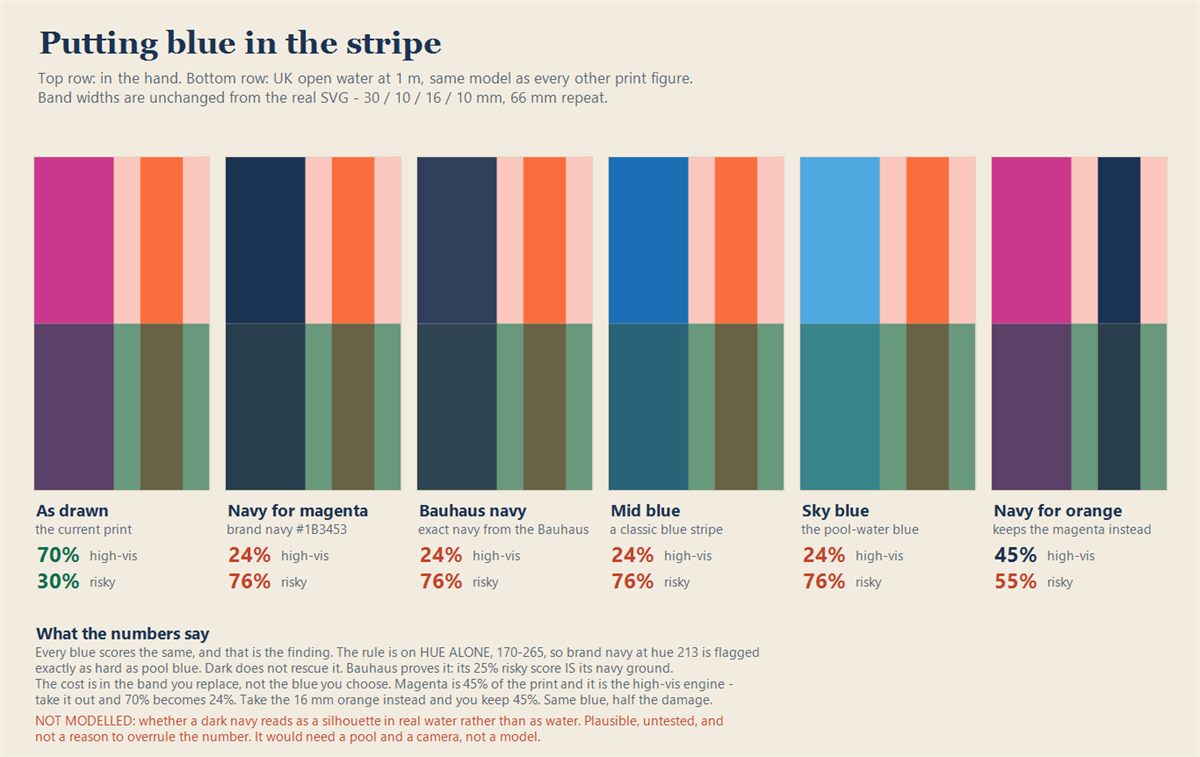
What happens if we put blue in. We wanted a blue stripe. Every blue scores identically, because the rule is on hue alone — a dark navy is flagged exactly as hard as a swimming-pool blue. What matters is which band you replace, not which blue you choose. We have not made this one.
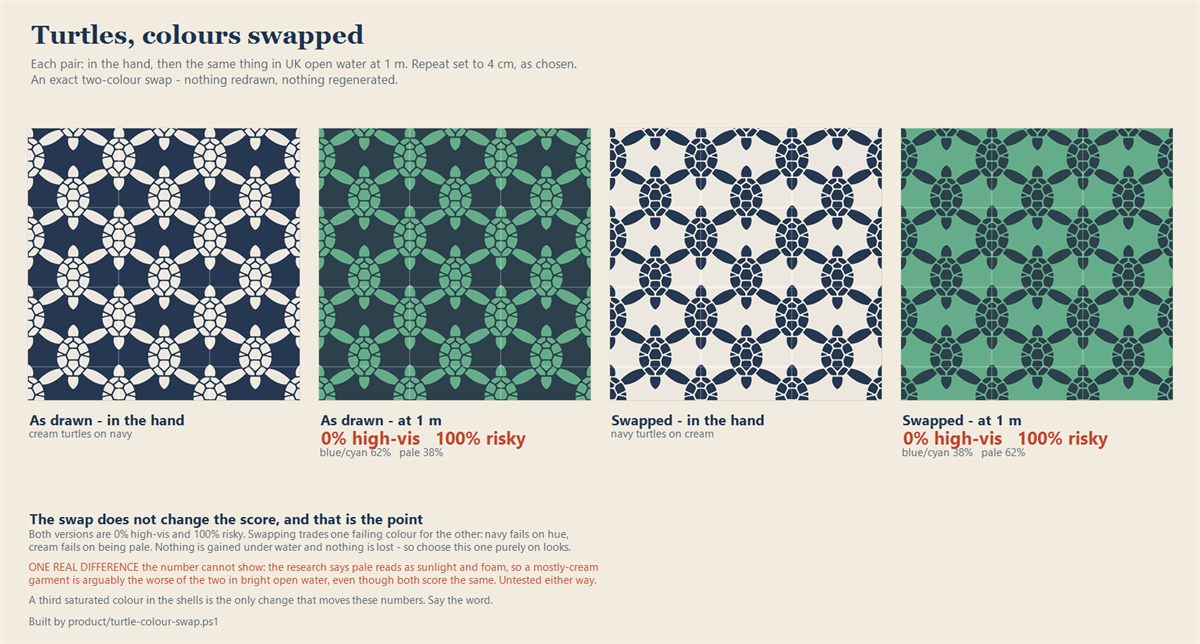
Sometimes the answer is that it makes no difference. The same print both ways round scores exactly the same, because navy fails on hue and cream fails on being pale. Worth knowing: it means that one is a decision about how it looks, and nothing else.
What is not here yet
Two things, and we would rather name them than let you notice.
Photographs of the garment. There are none, because it does not exist. We are choosing a factory. When there are samples there will be real photographs, and the mock-ups on this page will come down.
Our technical drawings. They exist — a technical flat and a points-of-measurement diagram — but the versions we have carry a placeholder version of our own logo, and we would rather not publish a drawing with the wrong mark on it. They go up when that is fixed.
There is a list if you want to follow along. It sees every print first and votes on the first patterns to be released.
Also worth reading
What colour swimwear can you actually see under water? — the full write-up of the first study above.
Why swim shorts have mesh liners — where they came from, and what to look for instead.
What size does my child need? — and why only one of our five size columns has actually been measured.